
“Everybody’s working on responsible hunting, making sure that their members are harvesting respectfully, and I think that’s really important for us to continue to do – to do that type of work collectively, sharing that knowledge and working together. And I see how it's inspiring a younger generation.
The Tłı̨chǫ have a lot of young participants in their monitoring programs who are continuously making themselves available to continue going on those programs. And with Thaidene Nene they have a lot of young people working in the park and through their nation with the guardianship programs for them to go out and monitor and make sure that everybody is respecting the land and the animals on our traditional areas. And I think that relationship has shifted from know the land and hunting on the land and harvesting caribou, to having a responsibility of caring for the caribou.
So there’s an older generation who were around, on the land and hunting when the population was healthy, like 500,000 caribou and it took days for the caribou herds to pass through certain areas and all these beautiful stories that we hear, to the generation that has worked for the diamond mines and have seen the decline. And then there's these youth now that are in their early twenties going out there, learning research methods to monitor the caribou. And they can talk about it in a way that is inspiring other community members and other youth to want to protect the caribou.
And I think that there’s a shift in our relationship where it’s our turn as humans to come in – even though it feels like we’re the reason for the decline – we’re shifting and working with a lot of Western science, like research, like universities and the government to stabilize the herd.”
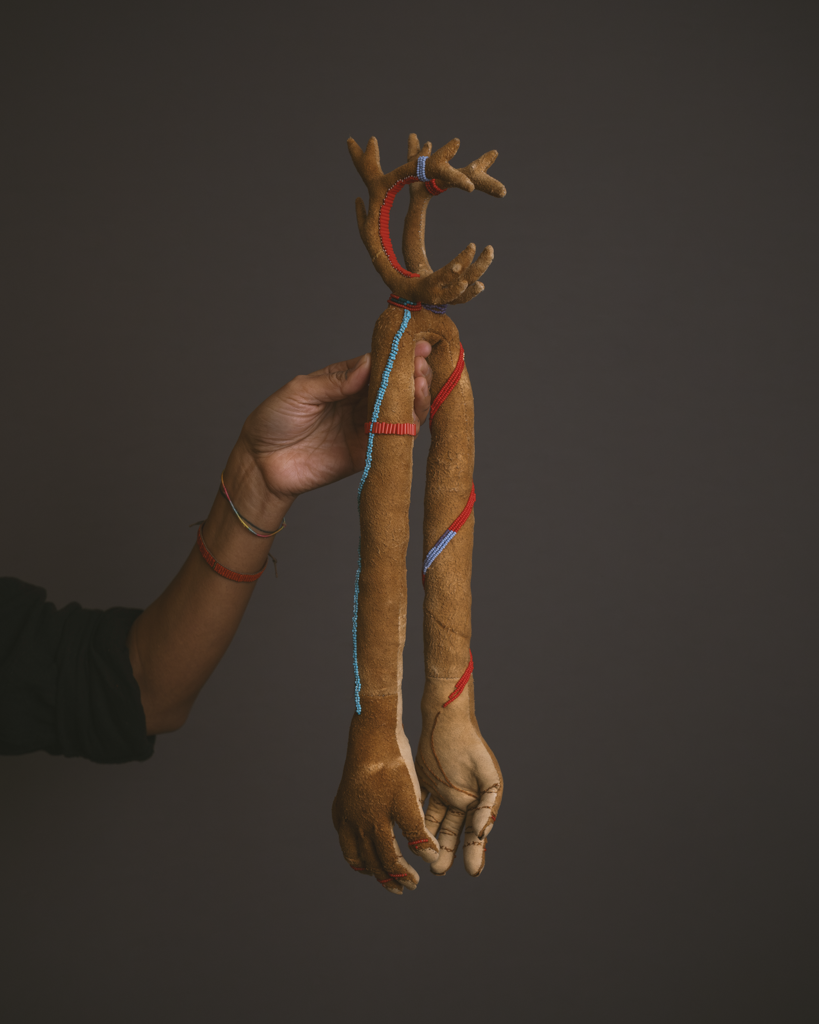
Nakehk’o uses tanned caribou hide to create artwork depicting caribou shapeshifting into humans. She says she thinks about what it would feel like to transform into a caribou, and what it is the space in between the spiritual realm. “What does that look like?” she asks.